
By clicking Get My Free Quote, I give Ohlmeyer Insurance (David Ohlmeyer Jr. Agency) and its licensed agents my prior express written consent, by electronic signature, to contact me with calls and text messages — including marketing calls and texts made using automated technology or an artificial or prerecorded voice — and by email, at the number and email I provided, about my insurance quote and related insurance products and services, even if my number is on a Do Not Call list. My information is never sold or shared with other agencies for their own marketing. Consent is not a condition of purchase; I can call (985) 876-0116 instead. Message frequency varies. Message and data rates may apply. Reply STOP to opt out, HELP for help. I agree to the Privacy Policy and Terms of Use, including the arbitration clause and E-SIGN consent.
Your house in Lafayette sits well inland, so the hurricane coverage on the evening news can feel like it’s about somebody else’s roof. Then you remember August 2016, when the Vermilion River and the coulees came up into neighborhoods across the parish, or the October night Hurricane Delta’s gusts came through town. Maybe your renewal just went up, or a nonrenewal letter showed up, and you want to know what actually matters for a home here.
Home insurance in Lafayette isn’t a coastal policy with a different ZIP code on it. The risk mix is different: storm surge stays mostly in the parishes to the south, while rain-driven flooding from the river and its tributaries, and hurricane wind that still reaches the city after landfall, do most of the damage. That changes which questions you ask first.
This guide covers how Lafayette’s risk differs from the coast, what the 2016 flood showed about flood insurance, how to find your flood zone on the parish’s current FEMA maps, how hurricane wind and the named-storm deductible work after storms like Laura and Delta, what to do about your roof, what happens after a nonrenewal and how to get a quote that holds up. Our Lafayette office is at 1019 E Saint Mary Blvd, near the UL Lafayette campus, and we also have offices in Houma and Raceland.
How is home insurance risk in Lafayette different from the coast?
The short answer: Lafayette sits inland, so storm surge is a smaller worry than in coastal parishes, but heavy-rain flooding along the Vermilion River and its coulees, plus hurricane wind after landfall, are the two risks that shape a Lafayette home policy.
Start with the water. Lafayette Consolidated Government (LCG) describes the Vermilion River as the major waterway winding through Lafayette Parish and the area’s stormwater outlet. It’s fed by a web of bayous and coulees, including Bayou Carencro, Bayou Queue de Tortue, Coulee Mine, Gaston Coulee and the Isaac Verot Coulee. LCG notes that the river’s flood stage at Surrey Street is about 10 feet, according to the USGS, and that at high stages the flow can actually reverse direction between the Pinhook Bridge and Long Bridge.
In plain English: when a slow storm parks over Acadiana, the water has to drain through the same channels that run behind a lot of Lafayette backyards. That’s rain flooding, not surge, and it can reach homes miles from any marsh. The same LCG page calls August 1940 the most severe flood in the area, when the Lafayette Airport rain station recorded 27.33 inches over four days, August 6 to 9.
Then the wind. Hurricanes that make landfall in southwest Louisiana often keep moving inland, and Lafayette has felt them. We cover Laura and Delta in the wind section below. For storm surge, look south: in Hurricane Delta, the National Weather Service reported surge of roughly 5 to 10 feet in Vermilion, Iberia and western St. Mary parishes, the coastal parishes below Lafayette.
| Lafayette risk | Which policy usually responds | What to check |
|---|---|---|
| River and coulee flooding from heavy rain | A separate NFIP flood policy. Homeowners policies exclude flood. | Separate policyBuilding and contents limits, and the 30-day wait. |
| Hurricane wind on the roof or siding | Your homeowners policy, if wind isn’t excluded. | Check the deductibleThe named-storm deductible, in dollars. |
| A tree falls on the house in a storm | Usually your homeowners policy, subject to its terms. | CoreDwelling limit and debris removal. |
| Rain that enters through a storm-damaged roof | Usually your homeowners policy, as part of the wind damage. | Check the basisReplacement cost or actual cash value. |
| Storm surge or rising water at ground level | Flood, so the NFIP policy, not homeowners. | Separate policyYour flood zone and elevation. |
What did the August 2016 flood show Lafayette homeowners about flood insurance?
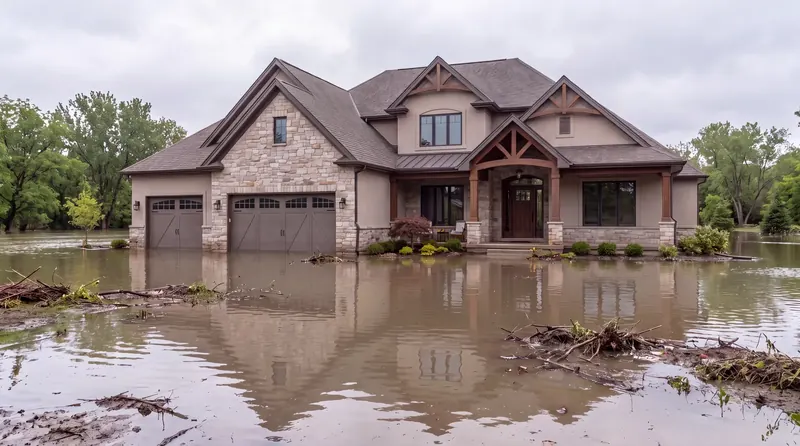
The short answer: The August 2016 rain flooded homes across South Louisiana that weren’t near the coast, and because homeowners policies exclude flood, only households with a separate flood policy had coverage for that water.
The U.S. Geological Survey’s report on the event, Characterization of Peak Streamflows and Flood Inundation of Selected Areas in Louisiana from the August 2016 Flood (Scientific Investigations Report 2017–5005), says heavy rain fell from August 11 to 14, 2016, with the heaviest reported total topping 31 inches. The flooding caused at least 13 deaths and damaged more than 140,000 homes in Louisiana.
LCG puts rainfall in the Vermilion River basin at roughly 12 to 26 inches over the event. The USGS ranked the 2016 peak streamflow at Surrey Street third among 48 annual peaks on record there, so it wasn’t even the highest the gauge has seen. That’s the point worth sitting with: a flood that damaged homes across Acadiana wasn’t a one-of-a-kind event at that gauge.
The insurance lesson is simple. A standard homeowners policy doesn’t cover flood, so only a separate flood policy already in place would have paid for that water. LCG reports that, as of October 2020, the National Flood Insurance Program had paid close to $200 million in flood claims in Lafayette Parish.
An NFIP policy for a homeowner covers up to $250,000 for the building and up to $100,000 for contents, according to FEMA’s FloodSmart. Under 44 CFR 61.11, a new policy generally takes effect 30 days after you apply and pay, with exceptions such as buying it when you close on a mortgage. Our Louisiana flood insurance guide walks through the exceptions and what the policy leaves out.
How do you check your Lafayette Parish flood zone, and does the CRS rating help?
The short answer: Look up your address on FEMA’s Flood Map Service Center or LCG’s map viewer, since Lafayette Parish’s current flood maps took effect on December 21, 2018, and ask whether your address shares in Lafayette’s Community Rating System discount.
According to LCG’s flood maps page, the most recent FEMA Flood Insurance Rate Map for Lafayette Parish went into effect on December 21, 2018. It replaced maps that dated to January 1996, with one small area changed in 1999. LCG links both a viewer for the 2018 maps and the historic maps on FEMA’s Flood Map Service Center, where you can search your own address.
Once you have your zone, FEMA’s What Is My Flood Zone? page explains the letters. Zones starting with A or V are high-risk areas, and if you have a federally backed mortgage on a home in one, flood insurance is required as a condition of the loan. Zones B, C and X carry moderate or lower risk, not no risk. FloodSmart says 1 in 3 flood insurance claims come from low- and moderate-risk zones.
Lafayette’s Community Rating System rating. The CRS is a voluntary FEMA program that rewards communities for floodplain management beyond the minimum, with classes running from 10 up to 1. On August 26, 2025, LCG announced that Lafayette retained its Class 7 rating after earning 1,630 points in its five-year review, against the 1,500 needed, with the rating taking effect April 1, 2026. LCG credits drainage maintenance, floodplain protections and public education.
What that means for you: eligible NFIP policyholders in the participating community get a discount on their flood premium, applied by the program. If your home is in Broussard, Youngsville, Scott, Carencro or the unincorporated parish, ask us to confirm how it applies at your address, since your flood zone, elevation and building still drive most of the price.
Does a Lafayette home policy cover hurricane wind, and how does the named-storm deductible work?
The short answer: Wind damage from a hurricane is usually a homeowners claim, but it often falls under a separate named-storm deductible set as a percentage of your dwelling limit, and Louisiana law applies it once per calendar year on owner-occupied homes.
Two 2020 storms show how wind reaches Lafayette from a southwest Louisiana landfall:
- Hurricane Laura came ashore near Cameron around 1 a.m. CDT on August 27, 2020, with sustained winds of 150 mph, according to the National Weather Service in Lake Charles. The National Hurricane Center’s Tropical Cyclone Report (May 26, 2021) logged a gust of 50 knots, about 58 mph, and 7.91 inches of rain at Lafayette’s station, and noted minor Vermilion River flooding in Lafayette Parish. The NWS lists Lafayette among the parishes where wind and falling trees damaged homes.
- Hurricane Delta made landfall near Creole at 6 p.m. CDT on October 9, 2020, with 100 mph winds, about 12 miles east of where Laura hit six weeks earlier. The NWS Lake Charles storm summary, which it labels preliminary, reports a peak gust of 75 mph at the Lafayette airport that evening.
Wind that lifts shingles, peels back a soffit or drops an oak on the roof is generally a homeowners claim. The catch is the deductible. Many Louisiana policies carry a separate named-storm or hurricane deductible written as a percentage of the dwelling limit, on top of the all-perils deductible you use for a kitchen fire or a burst pipe.
- With a 2% named-storm deductible, you pay the first $5,000 of covered storm damage.
- With a 5% named-storm deductible, you pay the first $12,500.
- A burst pipe in January would fall under the $1,000 all-perils deductible instead.
The once-a-year rule matters here. Laura and Delta hit the same corner of Louisiana six weeks apart. Under La. R.S. 22:1337, for homeowners policies on owner-occupied one- or two-family homes, the separate named-storm or hurricane deductible applies on an annual basis to all named-storm or hurricane losses in the calendar year. In plain English, a second storm in the same year doesn’t start a fresh full deductible.
The same statute requires a Commissioner-prescribed form listing each deductible as a percentage of the insured value, a dollar amount or both, and on new policies effective after January 1, 2023, the insurer asks you to sign it. Our hurricane insurance guide covers the second-storm math in detail.
What should Lafayette homeowners know about roofs, FORTIFIED and the Fortify Homes grants?
The short answer: Your roof drives both the price and the payout, so check whether it’s insured at replacement cost or actual cash value, and know that Lafayette Parish joined the Fortify Homes grant program’s eligible area for the 2026 round.
Replacement cost or actual cash value. Replacement cost pays to repair or replace the roof without subtracting depreciation. Actual cash value subtracts depreciation, so a payment on an older roof can come up well short of the roofer’s invoice. Some policies treat the roof differently from the rest of the house, so look for a roof endorsement or schedule on your declarations page. If you’ve replaced the roof since the policy was written, tell us, with the date and the receipts.
Lafayette Parish was added to the Fortify Homes area for 2026. The Louisiana Department of Insurance runs the Louisiana Fortify Homes Program, which offers grants of up to $10,000 toward a roof built to the IBHS FORTIFIED standard. For the 2026 round, the Houma Times reported on May 31, 2026 that the eligible area was expanding to include Acadia, Jefferson Davis and Lafayette parishes, plus previously excluded parts of Iberia, St. Martin, Vermilion and several other parishes. Here’s what that report describes:
- How it’s awarded: registration ran June 1 to June 19, 2026, and 3,000 participants were chosen by random lottery.
- What you need: a homestead exemption, a declarations page that includes wind coverage, and a flood declarations page if the home is in a flood zone.
- What you pay: an evaluation by a FORTIFIED-certified evaluator and any cost above the grant.
- Registering isn’t carried over: people who registered for an earlier round and weren’t selected had to register again for 2026.
The 2026 registration window has closed, and rules can change from round to round, so watch LDI’s Fortify Homes page before you sign a roofing contract.
Paying for it yourself? The Louisiana Department of Revenue’s Revenue Information Bulletin 25-020 (revised March 19, 2026) explains the credit created by Act 404 of 2025: a nonrefundable state income tax credit for qualified expenses to install a FORTIFIED roof on your homestead, up to $10,000 per residence, for expenses on or after July 1, 2025. IBHS must certify the roof, the program has a $10 million annual cap, and grant-funded expenses don’t count. Talk with your tax preparer before you count on it.
FORTIFIED premium discounts. Under LDI Regulation 136 and Bulletin 2026-04 (April 29, 2026), insurers must give discounts for FORTIFIED homes on new and renewed residential policies by January 1, 2027. LDI publishes its benchmark discounts by region and FORTIFIED level, and they apply to the hurricane portion of the premium, not the whole bill. Benchmarks vary by region and FORTIFIED level, and discounts are subject to terms, conditions and availability. If you already have a FORTIFIED certificate, send it to us so it’s on file before your renewal.
By clicking Get My Free Quote, I give Ohlmeyer Insurance (David Ohlmeyer Jr. Agency) and its licensed agents my prior express written consent, by electronic signature, to contact me with calls and text messages — including marketing calls and texts made using automated technology or an artificial or prerecorded voice — and by email, at the number and email I provided, about my insurance quote and related insurance products and services, even if my number is on a Do Not Call list. My information is never sold or shared with other agencies for their own marketing. Consent is not a condition of purchase; I can call (985) 876-0116 instead. Message frequency varies. Message and data rates may apply. Reply STOP to opt out, HELP for help. I agree to the Privacy Policy and Terms of Use, including the arbitration clause and E-SIGN consent.
What if your Lafayette home insurance is nonrenewed or hard to place?
The short answer: Starting July 1, 2026, insurers generally must give 60 days’ notice before canceling or nonrenewing a homeowners policy, except for nonpayment, and if no regular insurer will write the home, Louisiana Citizens is the state’s insurer of last resort.
A nonrenewal letter is stressful, but the notice period gives you room to act. Act 182 of 2025 (HB 345), effective July 1, 2026, raised the written notice for nonrenewing a homeowners policy and for canceling a policy from 30 days to 60 days. Cancellation for nonpayment of premium isn’t covered by that change, so keep your payments current.
When a letter arrives, call us that week, not the week it takes effect. The things that help most are your current declarations page, the roof’s age and material, any FORTIFIED certificate, and an honest list of past claims. Those details decide which options are open to you.
Louisiana Citizens, explained neutrally. Louisiana Citizens Property Insurance Corporation is the state’s insurer of last resort for homes that can’t get coverage in the regular market. It’s a safety net, and for most homeowners the goal is to move back to a regular policy when one becomes available. Our Louisiana Citizens guide explains who qualifies, what it covers and how to leave.
Ways to keep the premium in check without opening gaps. Bundling your home with your auto policy, protective devices like monitored alarms, a claims-free history and roof upgrades can all earn credits. Discounts vary and are subject to terms, conditions and availability. What we won’t suggest is dropping wind, skipping flood or setting the dwelling limit below rebuild cost to hit a number. Those are the cuts that cost the most after a storm.
How do you get a Lafayette home insurance quote that holds up?
The short answer: Bring your current declarations page, set the dwelling limit to rebuild cost, put the hurricane deductible in dollars, confirm wind coverage, price an NFIP flood policy and share roof and claims details up front.
A home quote is a set of coverage decisions with a price attached. Two quotes at different prices often aren’t the same coverage: one may carry a lower dwelling limit, actual cash value on the roof or a bigger hurricane deductible. Here’s how we build a Lafayette homeowners quote with you:
- Start with your current declarations page
It lists your limits, deductibles, endorsements and premium. Use it as the baseline so every change is on purpose.
- Set the dwelling limit to rebuild cost
Labor and materials, not the sale price or the tax assessment. Include additions, a new kitchen or recent elevation work.
- Look up your flood zone
Check your address on FEMA’s map service center or LCG’s 2018 map viewer, then price an NFIP policy at the same time as the home policy.
- Turn the hurricane deductible into dollars
Pick a level you could pay the week after a storm like Delta.
- Bring roof details
Age, material, replacement receipts and any FORTIFIED certificate all matter to the price and the payout.
- Be upfront about past claims
Mentioning that 2020 roof claim now means the quote is built on the full picture, not corrected after the fact.
Our Lafayette office is at 1019 E Saint Mary Blvd, near the UL Lafayette campus, and serves homeowners across the parish and nearby towns like Broussard, Youngsville, Scott, Carencro and Breaux Bridge. It’s open Monday through Friday, 8:00 AM to 5:00 PM Central, with weekend appointments available. The best times for a review are a few weeks before renewal, before June 1, and before you close on a house, since a lender will want proof of coverage and a flood policy’s waiting period can affect your timeline.
The bottom line
A Lafayette home policy has to answer two local questions: what happens when the Vermilion River and the coulees rise, and what you’ll pay out of pocket when a hurricane’s wind reaches town after landfall. That means a separate flood policy for the water a homeowners policy won’t touch, a hurricane deductible you know in dollars, a roof insured the way you expect and a dwelling limit that would rebuild the house.
Some rules are moving in homeowners’ favor: 60 days’ notice before a nonrenewal, a Fortify Homes grant area that included Lafayette Parish in 2026, and required FORTIFIED discounts on the hurricane portion of the premium by 2027. Use them.
Send us your ZIP below, or call or text our Lafayette office at (337) 232-1800. We’ll read your declarations page with you, check your flood zone and put your hurricane deductible in dollars, then quote the coverage you actually want. You can also visit our Lafayette office page, start on our home insurance page or go straight to a free quote. For the statewide picture, our Louisiana homeowners insurance guide covers every coverage line.
By clicking Get My Free Quote, I give Ohlmeyer Insurance (David Ohlmeyer Jr. Agency) and its licensed agents my prior express written consent, by electronic signature, to contact me with calls and text messages — including marketing calls and texts made using automated technology or an artificial or prerecorded voice — and by email, at the number and email I provided, about my insurance quote and related insurance products and services, even if my number is on a Do Not Call list. My information is never sold or shared with other agencies for their own marketing. Consent is not a condition of purchase; I can call (985) 876-0116 instead. Message frequency varies. Message and data rates may apply. Reply STOP to opt out, HELP for help. I agree to the Privacy Policy and Terms of Use, including the arbitration clause and E-SIGN consent.
Lafayette home insurance FAQ
Do I need flood insurance in Lafayette if my house didn’t flood in 2016?
It’s worth having either way. A standard homeowners policy excludes flood, so rising water from the Vermilion River or a coulee isn’t covered without a separate policy. FEMA’s FloodSmart site says 1 in 3 flood insurance claims come from low- and moderate-risk zones, and the USGS ranked the 2016 peak streamflow at the Surrey Street gauge only third among 48 annual peaks on record there. An NFIP policy covers up to $250,000 for the building and $100,000 for contents, and a new policy generally takes effect 30 days after you apply and pay, so buy it in a dry month, not when rain is in the forecast.
How do I find my flood zone in Lafayette Parish?
Search your address on FEMA’s Flood Map Service Center at msc.fema.gov, or use the 2018 flood map viewer linked from Lafayette Consolidated Government’s flood maps page. According to LCG, the current FEMA flood map for Lafayette Parish took effect on December 21, 2018, replacing maps that dated to 1996. Zones starting with A or V are high-risk areas, and a federally backed mortgage on a home in one requires flood insurance. Zones B, C and X carry moderate or lower risk, not no risk. If you’d rather not dig through maps, send us your address and we’ll look it up with you.
Does Lafayette get a flood insurance discount through FEMA’s Community Rating System?
Yes. On August 26, 2025, Lafayette Consolidated Government announced that Lafayette retained its Class 7 rating in FEMA’s Community Rating System, a voluntary program that rewards communities for floodplain management beyond the minimum. LCG said the city earned 1,630 points in its five-year review, against 1,500 needed, and that the rating takes effect April 1, 2026. Eligible NFIP policyholders in a participating community receive a discount on their flood premium. If your home is in another Lafayette Parish town or the unincorporated parish, ask us to confirm how the discount applies at your address.
Do hurricanes really damage homes as far inland as Lafayette?
They can. In Hurricane Laura in August 2020, the National Weather Service in Lake Charles listed Lafayette among the parishes where wind and falling trees damaged homes, and the National Hurricane Center recorded a 50-knot gust at Lafayette’s station. Six weeks later, Hurricane Delta made landfall near Creole, and the NWS reported a preliminary peak gust of 75 mph at the Lafayette airport. Wind damage is generally a homeowners claim, but it usually falls under a separate named-storm deductible, so check that percentage on your declarations page and turn it into dollars.
Can Lafayette homeowners get a Fortify Homes roof grant?
Lafayette Parish was added to the eligible area for the 2026 round of the Louisiana Department of Insurance’s Fortify Homes Program, according to a May 31, 2026 Houma Times report. That round offered grants of up to $10,000 toward a roof built to the IBHS FORTIFIED standard, with registration from June 1 to June 19, 2026 and 3,000 participants chosen by lottery. Applicants needed a homestead exemption, a declarations page showing wind coverage and, in a flood zone, a flood declarations page. That window has closed, so watch LDI’s Fortify Homes page for the next round and its rules.
Where is Ohlmeyer Insurance’s Lafayette office, and can I text it?
Our Lafayette office is at 1019 E Saint Mary Blvd, Lafayette, LA 70503, near the UL Lafayette campus. The office line, (337) 232-1800, takes both calls and texts. We’re open Monday through Friday, 8:00 AM to 5:00 PM Central, and weekend appointments are available. We help homeowners across Lafayette Parish and nearby towns such as Broussard, Youngsville, Scott, Carencro and Breaux Bridge. Bring your current declarations page, and we’ll review your dwelling limit, hurricane deductible, roof coverage and flood options with you. We also have offices in Houma and Raceland.
Last reviewed by David Ohlmeyer Jr. on .